> ## Documentation Index
> Fetch the complete documentation index at: https://docs.hubtalk.ai/llms.txt
> Use this file to discover all available pages before exploring further.
# Pre- and post-call functions
> Calls the agent makes into your systems before dialing and after the conversation: when they run, the Pipeline view, and where everything is documented.
# Pre- and post-call functions
A call function is a request the agent makes into your system **around** the conversation, not inside it. There are exactly two points:
* **before the call** — the result lands in dynamic variables, so the agent knows it from its first word;
* **after the call** — once at finalization, with the final variables, the call summary, and the post-call analysis result.
Both lists live in the agent document and are versioned with it: a live call reads them from the published version, an editor test reads them from the draft.
**There are no "during the conversation" functions here.** Anything the agent needs to ask mid-dialogue is done by flow nodes on the canvas — Function, Code, and MCP Tool. This page covers only what happens before the first word and after the last one.
## What this is for
**Before the call.** A campaign dials debtors. Before dialing, the agent looks up the name and the amount in billing. The person picks up and immediately hears: "Hello Alice, your balance for August is 12,400 tenge." Without this the agent would either stay silent for a few seconds while the request runs, or speak impersonally.
**After the call.** The conversation is over. The agent closes the ticket in the CRM, sends a summary to the manager in a messenger, and creates a task for an operator — but only if the call was actually successful.
## When exactly they run
When the "before the call" block runs depends on the direction.
| Direction | When | Block budget |
| --------------------------------------- | --------------------------------------------- | ---------------- |
| Outbound: campaign, cabinet, public API | **before dialing**, before the INVITE is sent | 60 s |
| Inbound, web call | after connect, before the first reply | 10 s |
| Chat test in the editor | before the test session starts | 10 s |
| The "after the call" block | at finalization, after post-call analysis | no shared budget |
The gap between 60 and 10 seconds is not arbitrary. On an outbound call the request runs **before the number is dialed**: the phone is not ringing yet, there is no silence on the line, so there is more time. On an inbound call the person is already on the line waiting — every extra second of silence is audible.
The budget is shared by the whole block, not per function. A single function still cannot wait longer than **30 seconds**, whatever the budget.
## The Pipeline view
Open the agent in the builder. In the header, under **Editor view**, there are two buttons: **Dialog** and **Pipeline**. Click **Pipeline**.
Instead of the dialogue canvas you get a single top-to-bottom column with the heading "Call pipeline · agent name". The side panels are hidden when you enter this view — that is normal, they are not gone: the inspector opens when you select a function card, and the left panel opens from a configure button, from the error counter, or from the header toggle. Switching back to **Dialog** restores the panels as they were.
The selected view is stored in the page address (`?view=pipeline`), so it survives a reload and the link can be shared in a ticket.
 The six blocks of the column, top to bottom:
| Block | What it shows |
| ----------------------- | ----------------------------------------------------------------------------------------------------------------------------- |
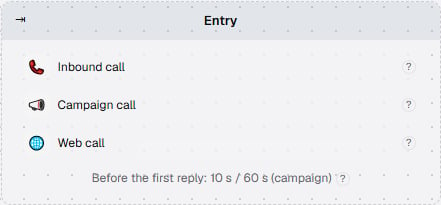
| **Entry** | three channels — inbound call, campaign call, web call — and the budget line "Before the first reply: 10 s / 60 s (campaign)" |
| **Pre-call functions** | cards of the functions that run before the conversation |
| **Agent** | flow name, number of nodes, knowledge bases, tools, and MCP servers |
| **Post-analytics** | what the system will compute for the conversation: summary, sentiment, success, model |
| **Post-call functions** | cards of the functions that run after the conversation |
| **Exit** | webhooks that will receive call notifications |
The connectors between blocks are labeled: **"Call started"** before the agent and **"Call ended"** after it.
The six blocks of the column, top to bottom:
| Block | What it shows |
| ----------------------- | ----------------------------------------------------------------------------------------------------------------------------- |
| **Entry** | three channels — inbound call, campaign call, web call — and the budget line "Before the first reply: 10 s / 60 s (campaign)" |
| **Pre-call functions** | cards of the functions that run before the conversation |
| **Agent** | flow name, number of nodes, knowledge bases, tools, and MCP servers |
| **Post-analytics** | what the system will compute for the conversation: summary, sentiment, success, model |
| **Post-call functions** | cards of the functions that run after the conversation |
| **Exit** | webhooks that will receive call notifications |
The connectors between blocks are labeled: **"Call started"** before the agent and **"Call ended"** after it.
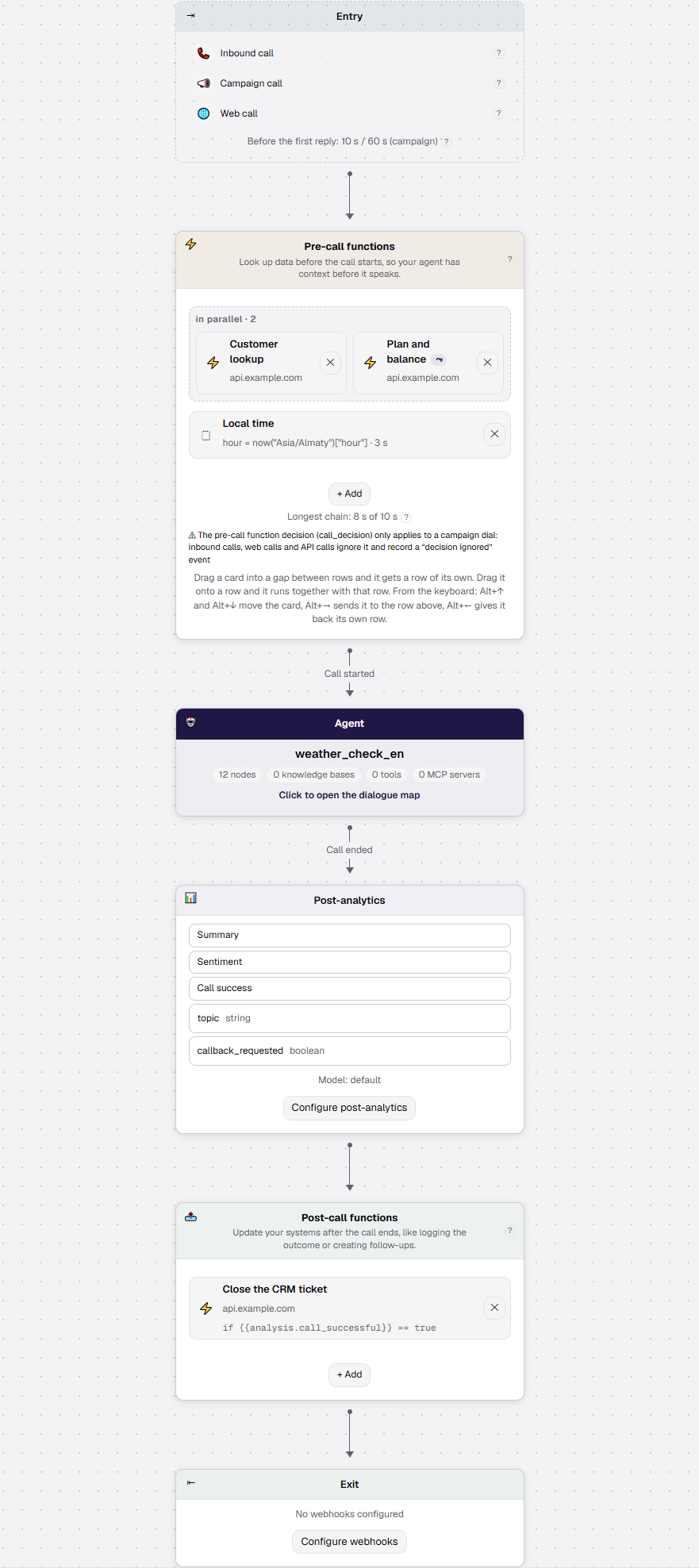 Only two blocks are editable in the pipeline — pre-call functions and post-call functions. The other four show settings and never duplicate their forms:
* **Post-analytics** and **Exit** carry the buttons **Configure post-analytics** and **Configure webhooks**, which open the **Settings** tab; the target section is highlighted for a few seconds so it is clear where you were taken.
* **Agent** is itself a button: clicking the card opens the Dialog view ("Click to open the dialogue map").
* **Entry** is a reference block with no actions; each channel carries a "?" hint explaining what that channel is.
Only two blocks are editable in the pipeline — pre-call functions and post-call functions. The other four show settings and never duplicate their forms:
* **Post-analytics** and **Exit** carry the buttons **Configure post-analytics** and **Configure webhooks**, which open the **Settings** tab; the target section is highlighted for a few seconds so it is clear where you were taken.
* **Agent** is itself a button: clicking the card opens the Dialog view ("Click to open the dialogue map").
* **Entry** is a reference block with no actions; each channel carries a "?" hint explaining what that channel is.
 ## Where everything is documented
Custom and code functions, result variables, row ordering and parallelism, trial runs and late delivery.
The run condition, the `call` and `analysis` variables, waiting for post-call analysis, and testing a condition without a call.
How a function cancels a dial or defers a contact before the phone ever rings, and what that does to the attempt.
What the platform sends, what it expects back, how the mapping works and which configuration keys exist.
What the call event feed shows, what the mechanism does not do, and what each symptom means.
## Where everything is documented
Custom and code functions, result variables, row ordering and parallelism, trial runs and late delivery.
The run condition, the `call` and `analysis` variables, waiting for post-call analysis, and testing a condition without a call.
How a function cancels a dial or defers a contact before the phone ever rings, and what that does to the attempt.
What the platform sends, what it expects back, how the mapping works and which configuration keys exist.
What the call event feed shows, what the mechanism does not do, and what each symptom means.