

Dialog model: nodes, transitions, one turn
Module goal: explain in your own words who decides what the agent says next — and why it is not decided by “the neural network in general”.
rigid mode looks like this:
The key rule: in one turn the agent either transitions or replies. The transition is chosen by a separate fast classifier model — it sees only the conditions of the node’s outgoing transitions, not your whole prompt.
Two kinds of nodes
- Dialog-leading — only
Conversation. The only type that asks the customer a question and waits for an answer. - Working —
Logic Split,Extract Variables,Function,Code,MCP Tool,Override Settings. They compute, extract, call external systems or change call settings, and move on right away.FunctionandMCP Toolcan say a short phrase while the call is running (Speak during), but they don’t wait for an answer. - Call-controlling —
End(finish, with a farewell phrase) andTransfer(transfer to a human; can say a phrase before the transfer). Begin— the start marker, andComponent— a link to a ready-made reusable block.
Why this way and not one promptOne big instruction like “talk to the customer about the appointment” breaks in three ways: it can’t be checked step by step, it forgets the mandatory questions, and it can’t be debugged precisely. The graph gives what a prompt lacks: a node that shows exactly where the conversation goes wrong; variables that are guaranteed to be filled; and a record of “where the call was” in the history of every conversation.
Click to open in full
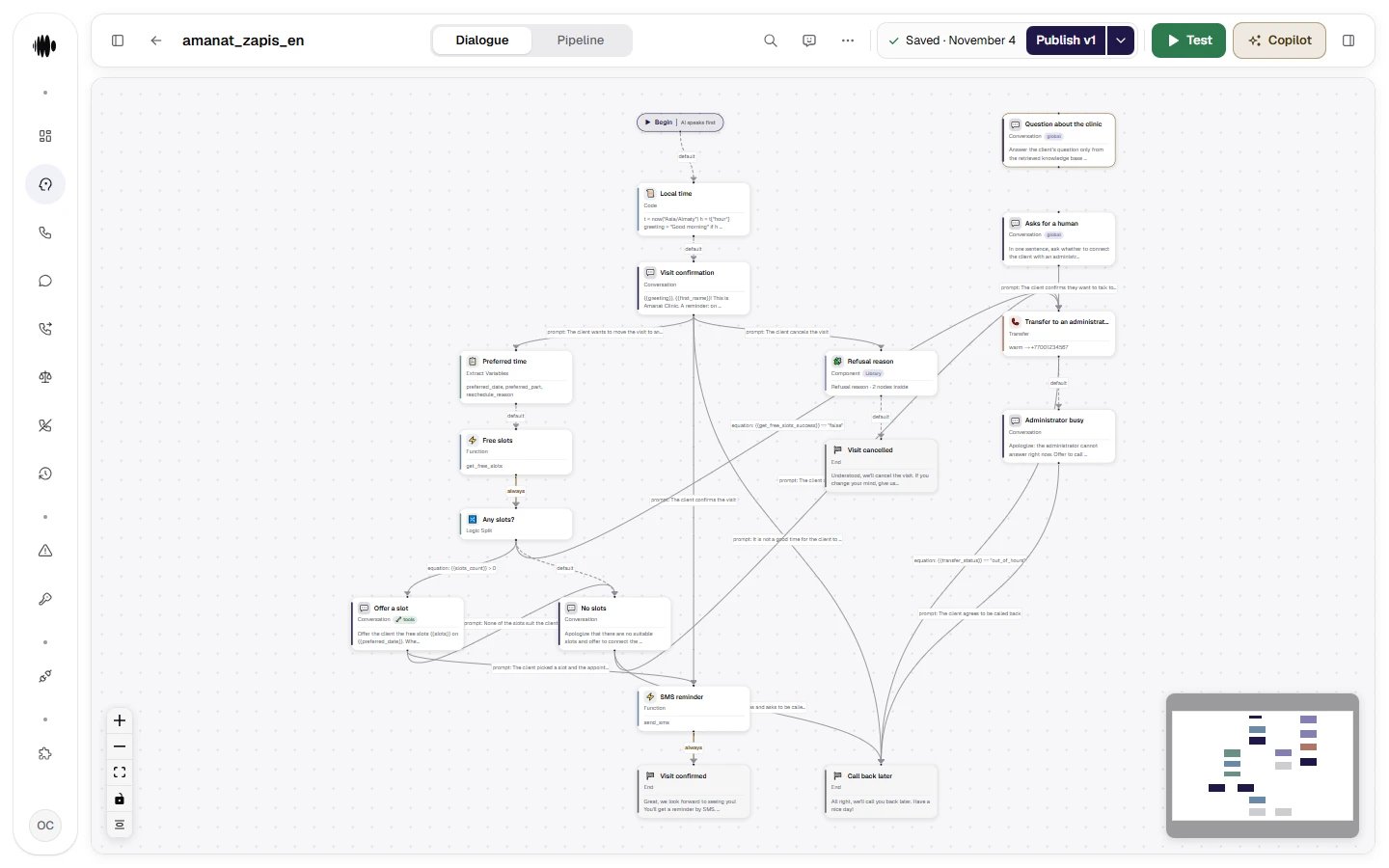
The course result. The agent you will build: visit confirmation, rescheduling via the CRM, questions answered from the knowledge base, transfer to the front desk, an SMS reminder and three different endings. 17 nodes is a normal size for a production agent.
Check yourselfAnswer without looking: 1) who chooses the transition — the execution model or the classifier? 2) which node type leads the dialog — asks and waits for an answer? 3) what happens if no transition condition matched?